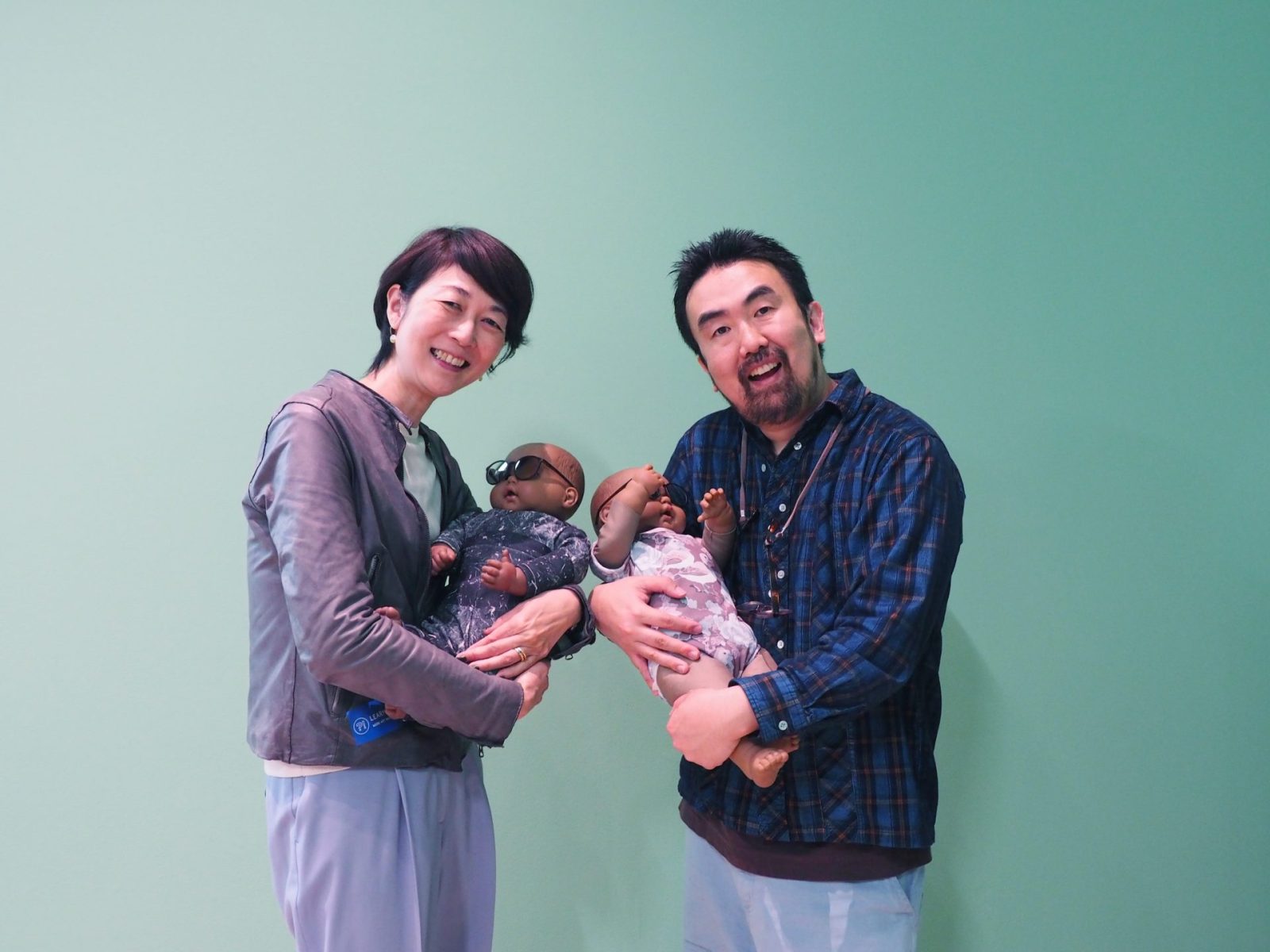
Holding the Baby doll to be exhibited at the Japan Pavilion. Left: Yuko Shiomi (Director, Arts Initiative Tokyo), Right: Ei Arakawa-Nash
Art Climate Collective Japan (ACCJ), led by the nonprofit organisation Arts Initiative Tokyo (AIT), will participate as a collaborator in the exhibition Grass Babies, Moon Babies by artist Ei Arakawa-Nash at the Japan Pavilion of the 61st International Art Exhibition of La Biennale di Venezia (2026).
Carbon footprint assessment and research by ACCJ will lead to a closing performance by Ei Arakawa-Nash in November
The International Art Exhibition of La Biennale di Venezia is one of the world’s largest exhibitions of contemporary art, held in Venice, Italy. This year, the Japan Pavilion will present the exhibition Grass Babies, Moon Babies by artist Ei Arakawa-Nash, co-curated by TAKAHASHI Mizuki and HORIKAWA Lisa.
Drawing on Arakawa-Nash’s experience of becoming a parent to twins in 2024, the exhibition explores the future through the act of ‘care’. Using the act of raising babies—symbols of the future—as a starting point, the Japan Pavilion will create a space for reflection on the society and environment of tomorrow.
In response to this future-oriented theme, environmental considerations for the Japan Pavilion have been explored, leading to the implementation of carbon footprint assessment and related research connected to the exhibition, with ACCJ participating in this initiative as a collaborator.
Commissioned by the Japan Foundation, the Japan Pavilion marks its 70th anniversary this year. In 2025, environmentally conscious renovation work led by architect Toyo Ito was completed through a donation from the Ishibashi Foundation. With cooperation from the artist, curators, production teams, and collaborators, the initiative aims to visualise the environmental impact of activities associated with the international exhibition, including production, transportation, installation, and operations, and to accumulate knowledge toward building sustainable exhibition models for the future.
Connecting Carbon Footprint Assessment and Artistic Practice
This initiative includes comprehensive carbon footprint assessment and analysis related to the operation of the Japan Pavilion, as well as research into sustainability efforts undertaken across the Venice Biennale and by other national pavilions. The scope of assessment includes processes such as artwork production, material procurement, transportation, on-site installation, and travel by participants. These processes will be examined through both quantitative data and qualitative reflection to visualise the realities of environmental impact within international exhibitions. A distinctive feature of this initiative is that it goes beyond assessment alone by connecting the results to artistic expression.
Building on the insights gained through ACCJ’s assessment and research, a closing performance by Ei Arakawa-Nash is planned for 22 November, the final day of the exhibition. This performance will attempt to transform environmental impacts, normally represented as numbers and data, into participatory bodily and poetic experiences. It will be positioned as a new artistic practice that moves between awareness and sensory experience in relation to the climate crisis.
About Crowdfunding Campaign
Ei Arakawa-Nash is currently running a crowdfunding campaign to support the creation of a work that can be experienced not only as documentation of the exhibition but also as a video work. Recognising that only a limited number of people are able to travel to Venice, the project aims to produce a new video work originating from the Japan Pavilion and to present it in Japan. The application period will close soon. We warmly invite your support.
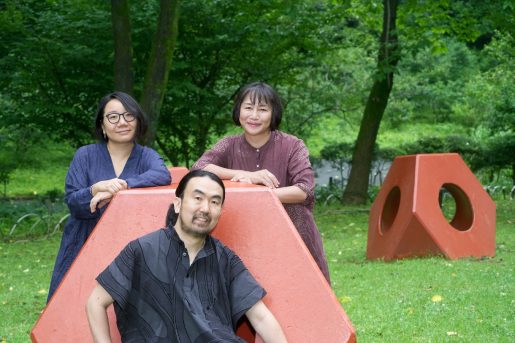
With Isamu Noguchi’s Octetra at Kodomonokuni (Children’s Land), Yokohama, Japan; Photo: Hako Hosokawa
※Campaign deadline: 12 April 2026 (Sunday), JST
Comment from Ei Arakawa-Nash
” As a performance artist, I have been flying continuously for the past 20 years, and my lifetime total flight distance has exceeded 1 million miles (approximately 1.6 million kilometers, or about 40 times around the Earth). Through art, I want to make the society I am part of a better place to live—but given this contradiction, what can I actually do? Is there a sustainable future for my twins?
We will calculate the Japan Pavilion’s carbon footprint because I felt it would be appropriate to present such a model at the Venice Biennale. It’s a small step. Guided by the ACCJ, I want to convey—through performance in November 2026—what art can contribute. “
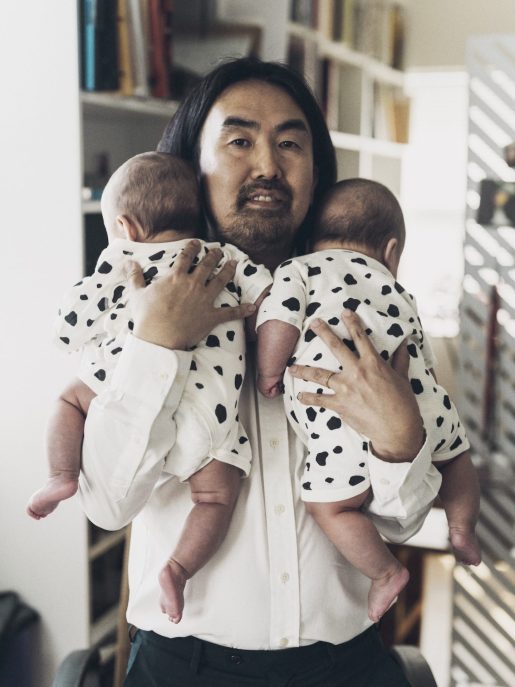
Ei Arakawa-Nash (born 1977 in Fukushima, Japan) is a Japanese American queer performance artist based in Los Angeles. Since the early 2000s, Arakawa-Nash has been at the forefront of expanding the international visibility and possibilities of performance art, drawing on—and reworking—its historical lineages, from Japan’s Gutai to New York’s Fluxus, Happenings, and Judson Dance Theater, as well as Viennese Actionism. After becoming a queer parent to twins in 2024, Grass Babies, Moon Babies marks their first major performance installation, framing care as a collective practice. By continuously working with others, they destabilize the subjective “I.” Their group performances emphasize the ever-present precarity of art objects and artist subjectivities. They are a professor in the Graduate Art program at ArtCenter College of Design in Pasadena, Los Angeles. They recently participated in exhibitions at Haus der Kunst (Munich, 2025), National Art Center, Tokyo (2024), CHAT – Centre for Heritage, Arts and Textile (Hong Kong, 2024), Tokyo Photographic Art Museum (2024), Kunsthalle Friart Fribourg (2023), Museion Bozen (Bolzano, 2023), Artists Space (New York, 2021), Tate Modern (London, 2021), Musée d’Art Moderne Grand-Duc Jean (Luxembourg, 2021), Honolulu Biennial (2019).
Comment from Yuko Shiomi

” We feel it is highly meaningful for ACCJ to participate in this initiative as a collaborator. A defining feature of this project lies in connecting carbon footprint assessment and research with Ei Arakawa-Nash’s artistic practice. How might environmental impacts, understood as numerical data, be transformed into bodily and sensory experiences? This process demonstrates new possibilities for how art can respond to the climate crisis.
We hope that insights generated through the Japan Pavilion team will be widely shared across future international exhibitions and museums, contributing to sustainable practices within the art sector in Japan. ”
About the Japan Pavilion at the 61st International Art Exhibition, La Biennale di Venezia
Title of Exhibition: Grass Babies, Moon Babies
Exhibition period: Saturday, May 9 – Sunday, November 22, 2026
Venue: The Japan Pavilion (in the Giardini, one of the Biennale venues)
Artist: Ei Arakawa-Nash
Co-curators: HORIKAWA Lisa (National Gallery Singapore, Senior Curator and Director (Curatorial & Collections)
TAKAHASHI Mizuki (Centre for Heritage, Arts and Textile, Hong Kong, Executive Director and Chief Curator)
Organizer/commissioner: The Japan Foundation
Special support: Ishibashi Foundation
Exhibition website: https://venezia-biennale-japan.jpf.go.jp/e/art/2026-en
Instagram: @japan_pavilion_vb2026
About the 61st Venice Biennale International Art Exhibition
Dates: Saturday 9 May – Sunday 22 November 2026
Venue: Giardini di Castello, Arsenale, and other locations
Organised by: Fondazione La Biennale di Venezia
Theme: In Minor Keys
Website: https://www.labiennale.org/en
The Venice Biennale is an art festival held in various locations across the island city of Venice, Italy. Since the first art exhibition was held in 1895, it has marked nearly 130 years of history. In recent years, international art festivals focused on fine arts have taken place in various parts of the world, but the Venice Biennale is the most renowned and has served as a model for these events. The term “Biennale” is Italian for “once every two years,” and many similar art festivals are called “Biennale” or “Triennale” (once every three years), following the example set by the Venice Biennale. Currently, it includes independent components such as art exhibitions, architecture exhibitions, music festivals, film festivals, and theater festivals, but the art exhibition in particular draws attention from the global art world as a venue for surveying contemporary art trends and as one of the few international exhibitions that adopts a national participation format. Japan made its first official participation in 1952, and following the completion of the Japan Pavilion in 1956, has continued to participate in every exhibition to date.
The Japan Foundation has been organizing the Japan Pavilion exhibition since 1976. For information about the artists who have represented Japan at the Japan Pavilion in the past, please refer to the archive site. Yayoi Kusama exhibited in 1993. ART | The Japan Pavilion Official Website – La Biennale di Venezia : https://venezia-biennale-japan.jpf.go.jp/e/art
About Art Climate Collective Japan (ACCJ)
Art Climate Collective Japan (ACCJ) is the country’s first arts–climate initiative. Launched by AIT in July 2024, it aims to build an environmentally conscious approach across the art sector by raising awareness and understanding of the climate crisis, sharing useful tools and resources for addressing it, and providing spaces for collaboration and support.
AIT joined the Gallery Climate Coalition (GCC) in 2021 and has been recognised as a GCC Active Member for three consecutive years since 2023.
https://accj.a-i-t.net/
※Gallery Climate Coalition (GCC) is a registered charity and an international membership organisation working to create an environmentally responsible art world. The coalition’s primary targets are to facilitate a reduction of the visual art sector’s greenhouse gas emissions by a minimum of 50% by 2030 and promote zero-waste practices. Its Active Membership is awarded annually to individuals and organisations that have demonstrated sustained environmentally responsible practices over the past year. https://galleryclimatecoalition.org/
Selected Climate Actions and Upcoming Initiatives by AIT
・July 2026 (scheduled) Publication of ACCJ annual journal ARON’S JOURNEY vol.2
・April 2026 (scheduled) Green Study Meeting vol.10: Re-reading Art History through Ecology: How Have Artists Responded to Environmental Crises? (AIT Room, Daikanyama)
・February 2026 Co-organised the symposium Museums and Climate Change: Toward a Sustainable Future, hosted by the National Center for Art Research (NCAR)
・January 2026 Participated in the forum Arts and Culture and Climate Action: Futures Emerging from Practice, hosted by Arts Council Tokyo
・December 2025 Green Study Meeting vol.4 (AIT Room, Daikanyama)
・July 2025 Launched ACCJ annual journal ARON’S JOURNEY vol.1
Initiated an interview series on responses to the climate crisis within the art sector in Japan
・June–July 2025 Green Study Meeting vol.7 and 8 (British Council Kagurazaka, Tokyo, Naebo Base, Sapporo)
・April 2025 Interview with Roger McDonald and Mami Kataoka published in the special issue Work for the Planet: Careers Connecting to the Next Generation, published by BRUTUS (Magazine House)
・April 2025 Green Study Meeting vol.6 (APK ROOM, TODA BUILDING)
・27 July 2024 Launched Art Climate Collective Japan (ACCJ) and opened its dedicated website
・27 July 2024 Symposium and Discussion : Art Takes Action for the Climate Crisis (Hillside Plaza, Daikanyama)
・May–July 2024 Green Study Meeting vol.4 and 5 (CADAN Yurakucho, AIT Room, Daikanyama)
・February 2024 Green Study Meeting vol.3 (Mori Art Museum, Roppongi)
・Since 2024 Recognised as Japan’s first GCC Active Member (second consecutive years)
・2023 Released the Japanese version (Ver.1) of the Decarbonisation Action Plan for Nonprofit and Public Organisations, developed by Gallery Climate Coalition (GCC)
・Since 2021 Ongoing publication of columns and interviews on climate crisis and art through the Bijutsu Techo Online and AIT Blog
・Since 2021 Joined Gallery Climate Coalition (GCC)
Press Inquiries
Arts Initiative Tokyo [AIT]
Haruna Takeda (Ms.) / Rie Okuma (Ms.)
otoiawase@a-i-t.net
Press Inquiries – Japan Pavilion, 61st International Art Exhibition of La Biennale di Venezia
International Press Inquiries
Beth Corner (Ms.)/ Charlotte Igarashi (Ms.)
Sutton Communications
E-mail: japanVB2026@suttoncomms.com
Japanese Press Inquiries
Yasuko Arita (Ms.) / Rasa Tsuda (Ms.)
E-mail: arita@earlypress.info